

Disposal instructions
Electrical and Electronic Equipment: Information for Households (Online)
The Electrical and Electronic Equipment Act (ElektroG) sets out a wide range of requirements for the handling of electrical and electronic equipment. The most important of these are summarised here.
1. Separate collection of waste equipment
Electrical and electronic equipment that has become waste is referred to as end-of-life equipment. Owners of end-of-life equipment must ensure it is collected separately from unsorted household waste. In particular, end-of-life equipment does not belong in household waste, but must be disposed of via special collection and return schemes.
2. Batteries, rechargeable batteries and light sources
Owners of waste electrical and electronic equipment must, as a general rule, separate used batteries and rechargeable batteries that are not enclosed within the waste electrical and electronic equipment, as well as light sources that can be removed from the equipment without causing damage, from the equipment before handing it in at a collection point. This does not apply where waste electrical and electronic equipment is sent for preparation for reuse with the involvement of a public waste management body.
3. Options for returning waste electrical and electronic equipment
Owners of waste electrical and electronic equipment from private households may hand these in free of charge at the collection points operated by public waste management authorities or at the take-back points set up by manufacturers or distributors within the meaning of the ElektroG.
You can find a take-back point near you at: www.take-e-back.de
Shops with a sales area of at least 400 m² for electrical and electronic equipment, as well as those food shops with a total sales area of at least 800 m² that offer and make available electrical and electronic equipment on the market several times a year or on a permanent basis, are obliged to take back such equipment. This also applies to sales made using means of distance communication if the storage and dispatch areas for electrical and electronic equipment amount to at least 400 m² or the total storage and dispatch areas amount to at least 800 m². Distance sellers subject to the take-back obligation must, as a general rule, ensure take-back by providing suitable return facilities within a reasonable distance of the respective end-user.
Distributors subject to the take-back obligation must, amongst other things, offer the option of returning a waste appliance free of charge when a new appliance of the same type, which essentially fulfils the same functions, is supplied to an end-user. Where a new appliance is delivered to a private household, the old appliance of the same type may also be handed over there for collection free of charge; this applies to sales made using means of distance communication for appliances in categories 1, 2 or 4 in accordance with Section 2(1) of the ElektroG, namely ‘heat exchangers’, ‘display devices’ or ‘large appliances’ (the latter having at least one external dimension exceeding 50 centimetres). End users are asked about their intention to return the appliance when concluding a sales contract. In addition, end users may return, free of charge, to the distributor’s collection points – irrespective of whether a new appliance is purchased – any waste appliances whose external dimensions do not exceed 25 centimetres in any dimension, subject to a limit of three waste appliances per type of appliance.
4. Data Protection Notice
Waste equipment often contains sensitive personal data. This applies in particular to information and telecommunications technology devices such as computers and smartphones. In your own interest, please note that each end user is personally responsible for deleting the data from the waste equipment to be disposed of.
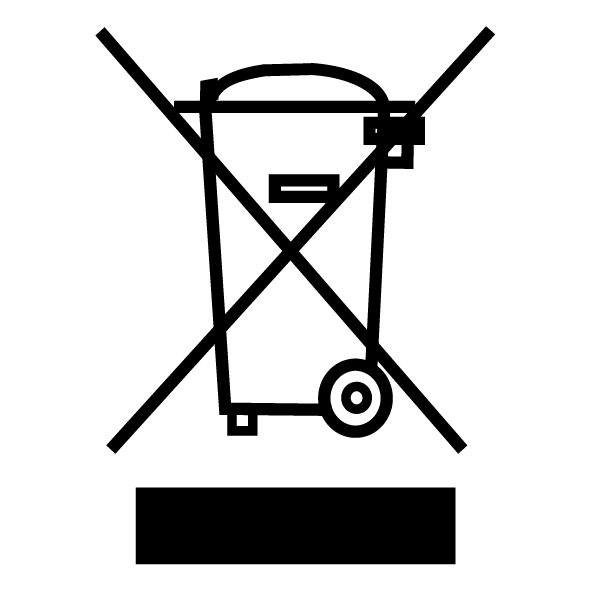
5. Meaning of the ‘crossed-out wheelie bin’ symbol
The symbol of a crossed-out wheelie bin, which is regularly displayed on electrical and electronic equipment, indicates that the device in question must be collected separately from unsorted household waste at the end of its service life.
6. Note on waste prevention
In accordance with the provisions of Directive 2008/98/EU on waste and its transposition into the legislation of the Member States of the European Union, waste prevention measures generally take precedence over waste management measures. In the case of electrical and electronic equipment, waste prevention measures include, in particular, extending their service life by repairing faulty appliances and selling second-hand appliances that are still in working order, rather than sending them for disposal. Further information is available in the Federal Government’s waste prevention programme, drawn up in collaboration with the federal states: